Magazine feature · October 1996
Yahoo!
Internet Life
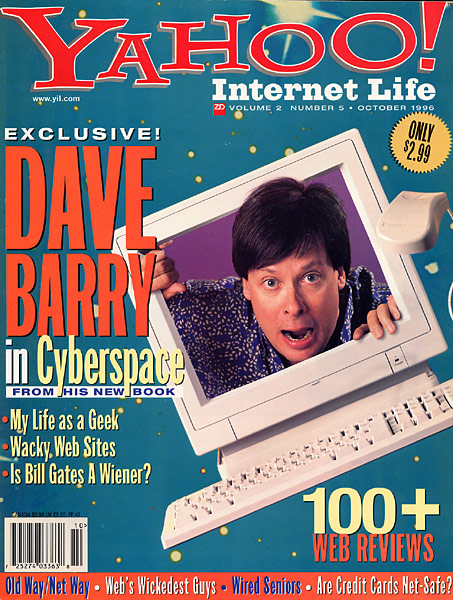
Rocktropolis in print.
A four-page feature preserved with the original Yahoo! Internet Life cover from the October 1996 issue.
Yahoo! Internet Life · Rocktropolis · October 1996
What most Web sites want, whether they realize it or not, is a sense of place. The language of the virtual is physical: You visit a site, you hang out there, and you split, usually never to return. Nowhere to go, nothing to do. Sometimes you don’t want clean, safe, and neat. Sometimes you want smoky atmosphere and pinball machines that work.
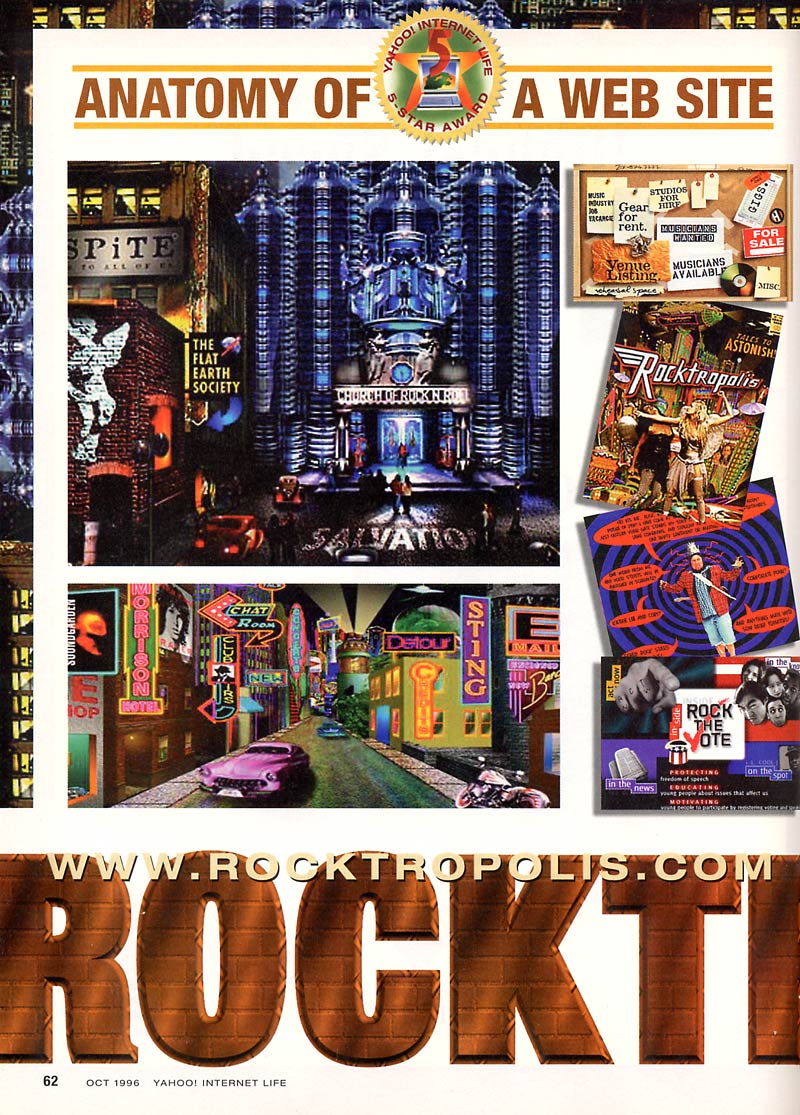
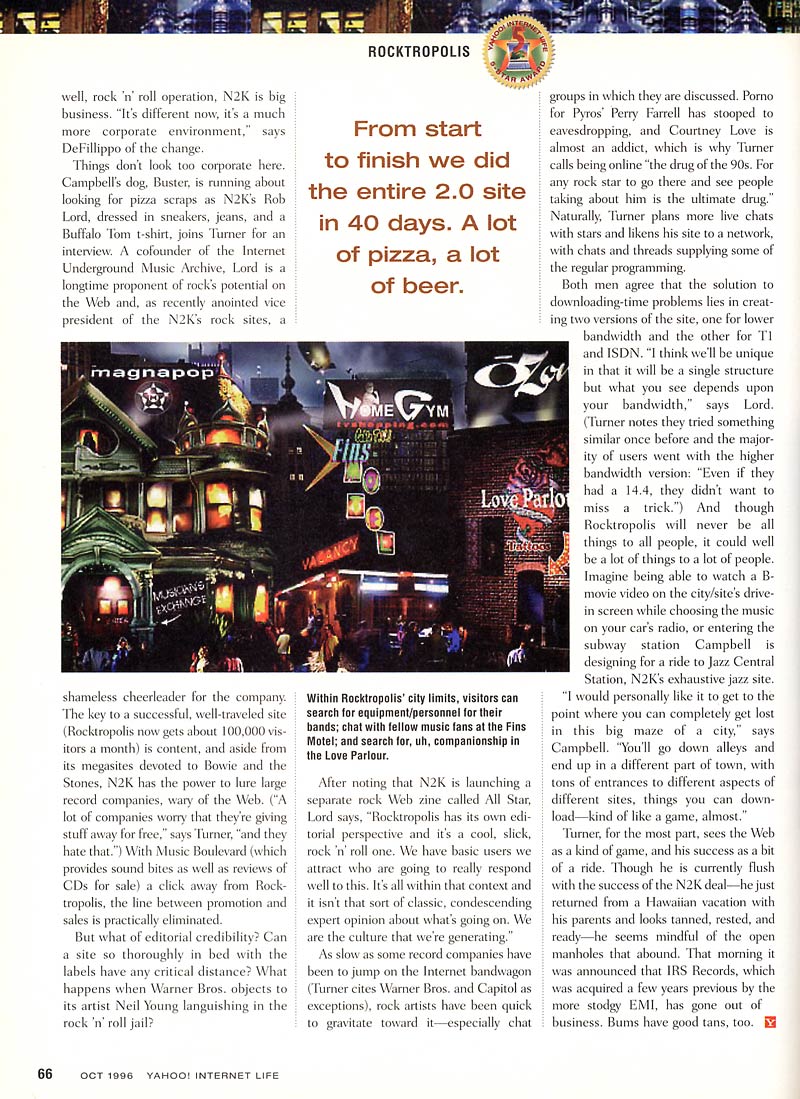
From the beginning, Rocktropolis had a sense of place. Billing itself as “a rock and roll fantasy theme park,” it presents the visitor with an unforgettable city vista, a Nighttown of dark alleys, bustling clubs, drive-in movies, and gas stations. Other rock sites have greater depth and resources, and are certainly quicker to download—the imposing SonicNet site (www.sonicnet.com) now stands as a model of Web efficiency, without forfeiting anything in the cool department—but unlike others, Rocktropolis has an element of mystery swirling around its corporate towers. Dark and murky—its home page background looks like a cyclone fence covered with black plastic—Rocktropolis has the look of a great, trashy album cover, the kind your parents would hate. Space-age buildings tower over seedy alleys, angels and flying saucers hover over women of the night. It’s a town where the moon is the only light you’ll see. In other words, a rock fan’s delight.
“As you probably noticed from my office, what is on the site stems from my love of mixing 50s rock ’n’ roll and Blade Runner,” says Rocktropolis founder and president, Nick Turner. He is sitting in aforesaid office, located in an art deco building on Sunset Boulevard in Hollywood that once housed the Screen Actors Guild; on the wall are posters for A Hard Day’s Night and the Sex Pistols (the site, too, welcomes all manner of music, from megastars to unsigned artists). There’s a microphone on his desk and a motorcycle in the corner; all it needs is Tuesday Weld and a power chord or two and you would have a set in a rock ’n’ roll fantasy. Like Rocktropolis.
Though drawn from our ubiquitous popular culture, Rocktropolis is very much Turner’s vision. He had the idea for many of the basic components, he found the people to bring it to fruition; his was a committee of one. More remarkably, he built his dream and sold it to the New York-based new media company N2K for a healthy profit while remaining in charge. And while the company stands to benefit from the sale (Rocktropolis will bring buyers to Music Boulevard, N2K’s online music store, as well as sell rock CDs on the N2K Encoded Music label), it’s good for the site as well. A company the size of N2K will lend Turner’s ground troops the air support they need, bringing them star content and technical power. It seems to actually be one of those elusive win/win situations widely sought and discussed by business people.
“I’m one of the few people who’ve actually made money on the Web,” says Turner. He’s being somewhat facetious, but while he may not yet be one of the richest people on the Web, he does seem to be one of the happiest.
The British-born Turner came to his calling honestly. A drummer for the 80s alternative band Lords of the New Church, he laid down the sticks to work for Miles Copeland, former manager of the Police and head of IRS Records (the Lords’ label as well). Turner was soon managing bands himself. He produced Sting’s CD-ROM All This Time for Starwave, and in the course of building a Web site for the singer hit upon the idea of doing a music channel for the Web. The Sting site became a mainstay of Rocktropolis as they welcomed the world in May of ’95 with a live chat featuring the surviving members of the Doors. The world—or at least the World Wide Web—sat up and took notice. There were stories in People and USA Today; Rocktropolis was named Cool Site of the Day that May, and was one of five finalists for the Cool Site of the Year of 1995. Today a search of “Rocktropolis” on the major keyword search engines reveals thousands of unique results, most of them links to www.rocktropolis.com.
“Everyone thought of Rocktropolis as this multimillion dollar enterprise,” says Turner, “when in reality it was me, some artists, and one programmer sitting in an office until five in the morning on weekends. But because of people like Sting and Daryl Hannah [one of the site’s guardian angels]—who’s a friend of mine—and the Doors, everyone thought of it as this huge undertaking.” In fact, the site then was being paid for by Turner’s management fees, until October of last year, when the new-media investors of Internet Holdings Group gave Turner the capital he needed to develop the site. He quit his day job, hired some artists, writers, and programmers, and headed off for a March ’96 relaunch with the top down and the pedal to the metal.
“From start to finish we did the entire 2.0 site in 40 days. A lot of pizza, a lot of beer.”
“The development time was rather rushed,” recalls Jason DeFillippo, Rocktropolis head programmer and technical developer. A lot of pizza, a lot of beer: the mantra of those in the trenches of new media. And this team did not have a blueprint to follow. “Nick said, ‘Make me a city,’” says DeFillippo. “We had the original Rocktropolis to go from, which was like a one-horse town, and we wanted to actually make it a walk-through environment.” Working with creative director Trevor Gilchrist, programmer Missy Leach, and artist Pietsie Campbell, he set out to create a CD-ROM-type adventure experience unlike anything else on the Web.
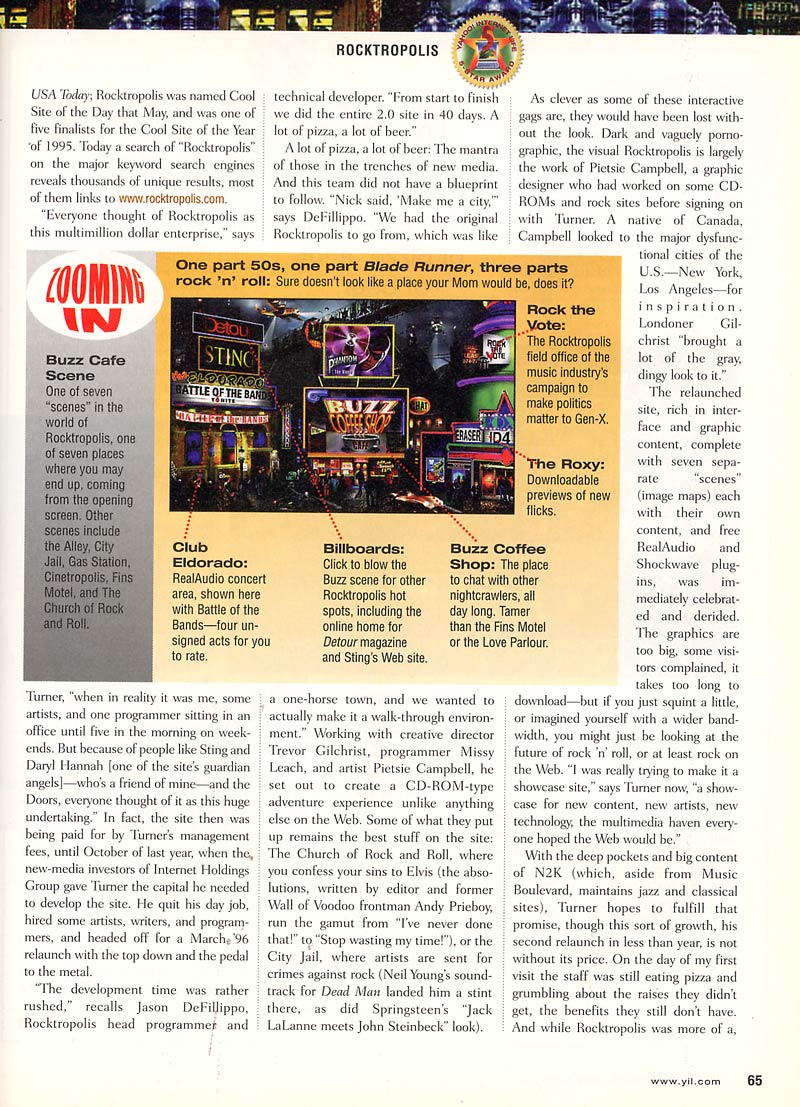
Some of what they put up remains the best stuff on the site: The Church of Rock and Roll, where you confess your sins to Elvis (the absolutions, written by editor and former Wall of Voodoo frontman Andy Prieboy, run the gamut from “I’ve never done that!” to “Stop wasting my time!”), or the City Jail, where artists are sent for crimes against rock (Neil Young’s soundtrack for Dead Man landed him a stint there, as did Springsteen’s “Jack LaLanne meets John Steinbeck” look).
As clever as some of these interactive gags are, they would have been lost without the look. Dark and vaguely pornographic, the visual Rocktropolis is largely the work of Pietsie Campbell, a graphic designer who had worked on some CD-ROMs and rock sites before signing on with Turner. A native of Canada, Campbell looked to the major dysfunctional cities of the U.S.—New York, Los Angeles—for inspiration. Londoner Gilchrist “brought a lot of the gray, dingy look to it.”
The relaunched site, rich in interface and graphic content, complete with seven separate “scenes” (image maps) each with their own content, and free RealAudio and Shockwave plug-ins, was immediately celebrated and derided. The graphics are too big, some visitors complained, it takes too long to download—but if you just squint a little, or imagine yourself with a wider bandwidth, you might just be looking at the future of rock ’n’ roll, or at least rock on the Web. “I was really trying to make it a showcase site,” says Turner now, “a showcase for new content, new artists, new technology, the multimedia haven everyone hoped the Web would be.”
With the deep pockets and big content of N2K (which, aside from Music Boulevard, maintains jazz and classical sites), Turner hopes to fulfill that promise, though this sort of growth, his second relaunch in less than a year, is not without its price. On the day of my first visit the staff was still eating pizza and grumbling about the raises they didn’t get, the benefits they still don’t have. And while Rocktropolis was more of a, well, rock ’n’ roll operation, N2K is big business.
“It’s different now, it’s a much more corporate environment,” says DeFillippo of the change.
Things don’t look too corporate here. Campbell’s dog, Buster, is running about looking for pizza scraps as N2K’s Rob Lord, dressed in sneakers, jeans, and a Buffalo Tom T-shirt, joins Turner for an interview. A cofounder of the Internet Underground Music Archive, Lord is a longtime proponent of rock’s potential on the Web and, as recently anointed vice president of N2K’s rock sites, a shameless cheerleader for the company. The key to a successful, well-traveled site (Rocktropolis now gets about 100,000 visitors a month) is content, and aside from its megasites devoted to Bowie and the Stones, N2K has the power to lure large record companies, wary of the Web. (“A lot of companies worry that they’re giving stuff away for free,” says Turner, “and they hate that.”) With Music Boulevard (which provides sound bites as well as reviews of CDs for sale) a click away from Rocktropolis, the line between promotion and sales is practically eliminated.
But what of editorial credibility? Can a site so thoroughly in bed with the labels have any critical distance? What happens when Warner Bros. objects to its artist Neil Young languishing in the rock ’n’ roll jail?
After noting that N2K is launching a separate rock Web zine called All Star, Lord says, “Rocktropolis has its own editorial perspective and it’s a cool, slick, rock ’n’ roll one. We have basic users we attract who are going to really respond well to this. It’s all within that context and it isn’t that sort of classic, condescending expert opinion about what’s going on. We are the culture that we’re generating.”
As slow as some record companies have been to jump on the Internet bandwagon (Turner cites Warner Bros. and Capitol as exceptions), rock artists have been quick to gravitate toward it—especially chat groups in which they are discussed. Porno for Pyros’ Perry Farrell has stooped to eavesdropping, and Courtney Love is almost an addict, which is why Turner calls being online “the drug of the 90s. For any rock star to go there and see people talking about him is the ultimate drug.” Naturally, Turner plans more live chats with stars and likens his site to a network, with chats and threads supplying some of the regular programming.
Both men agree that the solution to downloading-time problems lies in creating two versions of the site, one for lower bandwidth and the other for T1 and ISDN. “I think we’ll be unique in that it will be a single structure but what you see depends upon your bandwidth,” says Lord. (Turner notes they tried something similar once before and the majority of users went with the higher bandwidth version: “Even if they had a 14.4, they didn’t want to miss a trick.”) And though Rocktropolis will never be all things to all people, it could well be a lot of things to a lot of people.
Imagine being able to watch a B-movie video on the city/site’s drive-in screen while choosing the music on your car’s radio, or entering the subway station Campbell is designing for a ride to Jazz Central Station, N2K’s exhaustive jazz site. “I would personally like it to get to the point where you can completely get lost in this big maze of a city,” says Campbell. “You’ll go down alleys and end up in a different part of town, with tons of entrances to different aspects of different sites, things you can download—kind of like a game, almost.”
Turner, for the most part, sees the Web as a kind of game, and his success as a bit of a ride. Though he is currently flush with the success of the N2K deal—he just returned from a Hawaiian vacation with his parents and looks tanned, rested, and ready—he seems mindful of the open manholes that abound. That morning it was announced that IRS Records, which was acquired a few years previous by the more stodgy EMI, has gone out of business. Bums have good tans, too.